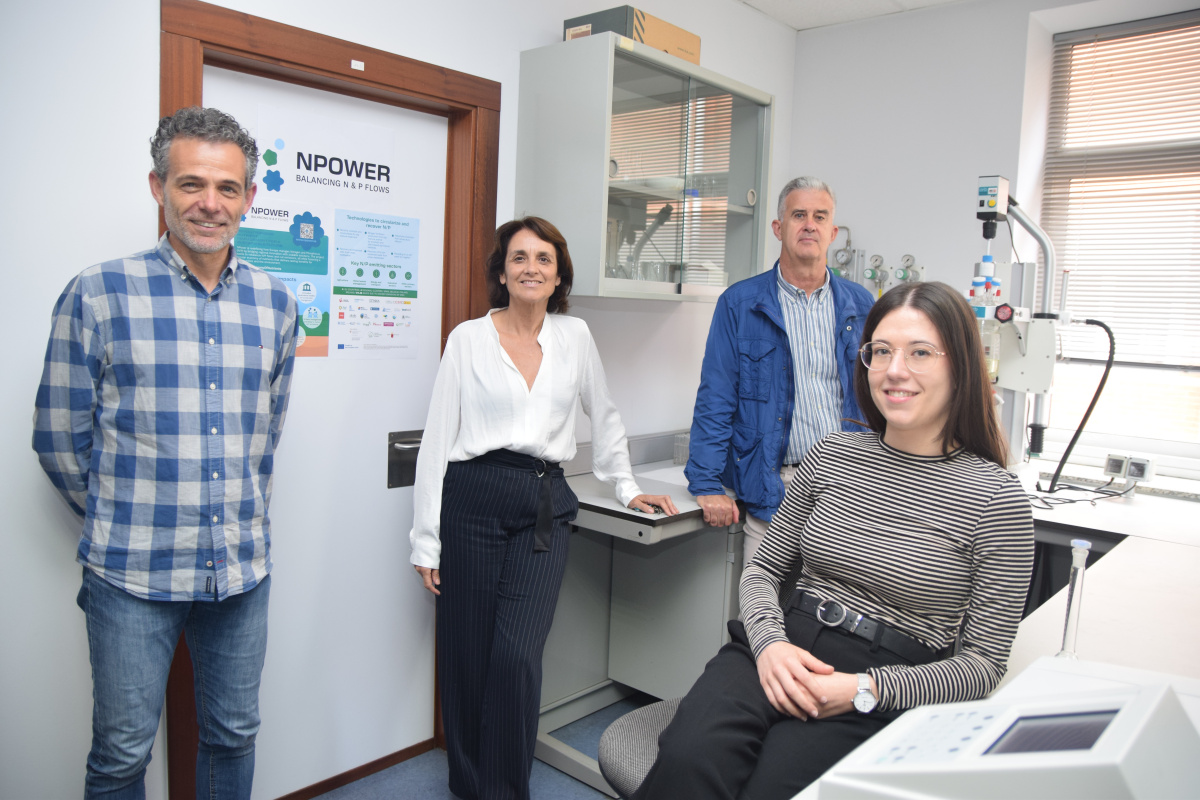
 From left to right: José M. Angosto, Mercedes Alacid, José A. Fernández-López and Pilar Villaescusa, from the UPCT team.
A new open-access study by NPower partner UPCT identifies the main nitrogen and phosphorus hotspots in the Region of Murcia and proposes an order of priorities for action. The framework provides a simplified systems-level overview that complements subsequent detailed nutrient flow analyses and the identification of best management practices within the project.
Researchers at the Technical University of Cartagena (UPCT) have analysed nitrogen (N) and phosphorus (P) flows in the Region of Murcia for 2020–2023. The analysis relies mainly on official regional data and covers three parts of the system together: crop production, livestock production and the population.
Crop production was the main source of nutrient imbalance. Every year, farmland received more nitrogen and phosphorus than crops used. On average, 39 kg of nitrogen and 13 kg of phosphorus per hectare were left over in the soil, particularly in intensive horticulture. Across the region, this surplus is larger than the amount of nutrients contained in everything the crops produce. Nitrogen not absorbed by crops can be lost to the air, and surpluses of both nutrients can reach water, contributing to pollution and eutrophication. The study recalls that this production model has contributed to nitrate pollution and the degradation of ecosystems such as the Mar Menor.
Livestock excreta, mostly from the pig sector, were the main recoverable nutrient pool and substantially exceeded the amount of manure used in agriculture. In the urban system, around 42% of nitrogen and 58% of phosphorus ended up in landfills.
Based on these results, the authors propose three priorities: address nutrient imbalances in crop production, contain livestock nutrients at source and redirect them, and mobilise nutrients from urban waste and wastewater. According to the study, imbalances and losses should be addressed before recirculation. Otherwise, recovered nutrients may return to parts of the system where surpluses remain.
The framework uses readily available data and is intended as a screening tool to help prioritise interventions. The authors note that it could be applied in other regions with intensive crop and livestock systems, depending on the availability of comparable data.
The authors present this prioritisation as a starting point: it should inform, not replace, subsequent detailed nutrient flow analyses and assessments of which specific measures are feasible and effective.
The article, A simplified systems-based screening framework for advancing nitrogen and phosphorus circularity in intensive agricultural regions, by Pilar Villaescusa, José M. Obón, José M. Angosto and José A. Fernández-López, is published in Agricultural Systems.
Read the full article